

Bylaws of Flourishing
Bylaws of Flourishing – the Humanist Life-Stance Association
Adopted 23 March 2025, Safnahúsið, Reykjavík
Additions pursuant to national legislation no. 108/1999 [see amendment history below] adopted by the Board 16 October 2025.
Article 1. Name, Role, and Objectives
1.1. The association is named Flourishing – a humanist life-stance association. As a life-stance association it operates in accordance with national legislation no. 108/1999 on religious and life-stance associations, as amended.
1.2. Its domicile is in Iceland and its venue (legal forum) is in the capital area.
1.3. Information provision and publication of the bylaws, ideological foundation, ethical guidelines, resolutions, and important notices shall take place on the association’s website (www.farsaeld.is). With the principal documents of the association, an amendment history shall be published as footnote text (or in another clear manner). The Board may also decide to issue supplementary material or further explanations of the documents. The association is authorized to establish an (electronic) mailing list of members, subject to each individual’s consent to participate.
1.4. Its principal role and objectives are to:
● defend and maintain associative activity organized around moral and epistemic realism (or naturalism) which, in its diverse ideological and practical forms, falls within common humanist secular humanism. (See further in the documents Ideological Foundation of Flourishing and Ethical Guidelines of Flourishing.)
● maintain educational and training activity on ethics and critical thinking. (See further later in the document on educational policy.) This may include, inter alia, the holding of shorter or longer courses, symposia, individual discussion meetings, debates, training in critical thinking, and so forth.
● defend and address the common humanist (secular) organization of society, where the constitution, laws, the legislature, the executive branch, and institutions of the state and municipalities are based on and operate on a common human basis without labels of particular religious or life-stance associations or political ideologies. (See further in Flourishing’s Policy on Freedom of Life-Stances and Equal Treatment.)
● conduct ceremonies on the basis of humanist ideology. Flourishing shall provide education, training, and quality assessment of celebrants and determine the field and scope of its ceremonial services. Under Act no. 108/1999, as amended, celebrants [deputies performing the official duties of the head] shall sign a declaration to the effect “to perform with vigilance and conscientiousness the duties that the office places upon [them]” and “to declare [their] fitness for the office” in accordance with this Act and the provisions of Chapters III and IV of the Marriage Act (no. 31/1993). Celebrants shall have reached at least 25 years of age. [See further later in the document on policy for Flourishing’s ceremonial services.]
● cooperate with domestic, foreign, or international movements of humanism or ethical realism. The Board may also decide that the association participates in cooperation on the basis of a consultative forum of religious and life-stance associations, or in temporary/long-term cooperation with other types of associations connected to the association’s objectives.
Article 2. Membership and Governance
2.1. Legally competent individuals who understand and wish to support the association’s objectives may become full members.
2.2. Full members and their rights. Members are those legally competent individuals who register with the association through the secretary/treasurer or another administrator/registrar of Flourishing’s membership register (as decided by the Board regarding registrations) and have paid a membership fee (as decided by the Board regarding its existence or amount). A full member’s voting right at the annual general meeting is conditional upon having registered in the association the previous year and, as applicable, upon the member not owing the membership fee for that year, if such fees are in force. Eligibility for election (the right to stand) and the right to submit motions are not subject to this condition of having registered the previous year (see instead Article 2.42 Nomination deadline and presentation). Full members have the right to submit proposals for amendments to the bylaws, which must be submitted at least 21 days before the annual general meeting. They also have the right to oral or written contributions regarding amendment proposals from the Board or other members. Final proposals shall be in writing. (See further under Article 2.31c.)
Board decisions on an annual membership fee shall be published on the association’s website. A member’s registration remains valid until the person notifies a different intention. The treasurer on the Board is responsible for the membership register.
It is permitted to register legally incompetent persons in the association, but they shall be considered auxiliary members and do not have eligibility for election (voting rights, candidacy rights, or motion rights). Efforts shall be made to obtain their independent decision regarding full membership once legal age is reached, as feasible. [Explanation: In the registration of individuals at the National Registry in religious or life-stance associations, this distinction is not made and all members aged 16 or older form the basis for the allocation of sóknargjöld (parish fees) to the associations.]
2.3. Governance structure and decisions under the bylaws.
2.31. Governance shall be based on informed democracy, which includes:
a. Substantive deliberative democracy (SDD) (see further in Substantive method and process), which the Board manages under the leadership of the Chair. All matters of the association fall under this route except those that the bylaws specify as subject to substantive voting democracy. Further provisions on substantive mindset and competence in association work are set out in the document Standards for the work and working practices of the Board and councils/committees. Persons serving on the Board, councils, committees, or in other roles for the association shall keep these standards, the ideological foundation, the ethical guidelines, and other documented policies of the association as guiding principles.
b. Substantive voting democracy (SVD), which involves open or secret ballots (as applicable) on matters of the association or on roles/positions of members within it in the following cases:
■ Within the Board when informed and substantive discussion has not produced the result of good consensus on a matter. (See further in Article 2.32.)
■ Among all full members when a majority of the Board or the Chair refers a matter to such a vote.
c. Composition of the Board and scope of authority.
■ Number of Board members, roles, and terms. The founding meeting of the association reaches agreement or elects by vote five qualified persons to the principal Board and two persons to the alternate Board. (If there are insufficient nominations, this may be reduced to 3+1.) The elected Board makes a documented internal agreement on its roles: Chair, Vice-Chair, Treasurer, and Board member, and publishes it together with an agreement on term lengths, which may be 1–3 years for the Chair and 1–2 years for other Board members. It is desirable that a member running for the Board state their intended term length (within the above limits) in the presentation of their candidacy. The role of meeting secretary need not be permanent and may also be provided as external assistance (or recording), as decided by the Board. The Board may invite persons outside the Board to Board meetings to obtain information or to discuss matters concerning the association. Board members have a duty of confidentiality regarding sensitive or personal matters that may be discussed.
■ Eligibility for election as Chair or Board member. Eligibility requires (i) full membership and (ii) that the person has additionally earned the Board’s trust (or credibility) as a suitable participant in substantive discussion, standards of critical and impartial thinking, moral judgment, and knowledge of the humanist ideological foundation. Suitability here also means at minimum that persons are not disruptive, obstructive, or harmful to the Board’s work; the aim, however, shall be the best: that they are constructive for Board work and the association. See the document Standards for the work and working practices of the Board and councils/committees. Thus, it shall not be permitted to elect or select unknown persons or persons about whom there is doubt as to whether they meet suitability for Board service. The sitting Board determines these conditions (pursuant to point (a) of Article 2.31 and point (a) of Article 2.32) and may further develop these documented standards as guidance. This applies equally to election as Chair, Vice-Chair, and other seats on the principal or alternate Board. Eligibility also requires a clean criminal record and, pursuant to Act no. 108/1999, a candidate for Chair must have reached 25 years of age at election and be liable for parish fees (sóknargjöld) in Iceland. Board members must have at least half of their number resident in Iceland, or one more if the number is odd. Board members, the head [Chair], and deputies [ceremony leaders] shall at all times meet the statutory eligibility requirements for service on the Board of the association. If Board members, an appointed custodian of funds [or, as applicable, an executive director] lose eligibility for Board service or the office, they shall inform the District Commissioner (sýslumaður) of this. Board members shall give a true and correct account of the association’s circumstances in public advertisements or notices, reports, annual accounts, or notifications to the District Commissioner.
■ Selection and approval of Board members. The Board may itself decide on the selection and approval of persons for Board service in all roles other than Chair and Vice-Chair, which shall take place at the annual general meeting. The Board may decide to entrust the annual general meeting with the election of all Board members, as applicable and by its majority decision. The Chair and Vice-Chair have the right to serve for the term length stated in the Board’s published approval, following their election. The Board may decide to change the term length of its own Board members according to the discussion rule in point (a) of Article 2.32, but at most within the maximum number of years specified in the bylaws. Principal Board members have the right to propose motions and to vote, while alternate members have only the right to propose motions, except when they substitute for a principal member at the Chair’s request. The right to propose motions includes the right to discuss matters and submit proposals for decision by the Board.
■ Non-objective behaviour or ethical breaches. If a Board member or alternate (or another person who holds any role for the association) is found to engage repeatedly in disruptive or improper behavior or non-substantive participation in discussions, the Chair, after consultation with the Vice-Chair or others on the Board, may seek corrective measures with the person concerned. If improvement is insufficient, the Chair, with the support of a majority of the Board as applicable, may take steps to remove the person from the Board (or another role). The same may apply to breaches of ethical guidelines, good morality, or conduct against the association’s objectives and ideological foundation. Moderation, consideration, sound justification, and candour shall be observed in all such interactions. See further on the Board’s procedures in Article 2.32b.
■ The Board’s authority to amend bylaws and the amendment process. The Board may propose bylaw amendments and approve them itself for an open amendment process, provided that the Chair and at least 3 of the other 4 Board members support the proposal. The Chair shall ensure that proposals have received careful review and discussion within the Board before being brought to open discussion. Two types of amendment process are permitted: (a) through an open amendment meeting and subsequent Board decision, or (b) through the annual general meeting and adoption there (see Article 2.41 Content and scope of the annual general meeting). A proposed amendment must be published on the website (and announced more widely insofar as communication channels to members extend at the time) at least 28 days before the date of final adoption by the Board (route a). The Board shall convene an Amendment Meeting 14 days after publication and invite members to discuss the proposal and to submit written amendment proposals there, if desired, or otherwise submit them at the latest (by submission) 5 days before the Board’s scheduled decision date (28–32 days after publication). The Board shall discuss with persons who wish to comment and may thereafter decide on further discussion or adoption, with amendments as applicable. Final Board adoption requires the above majority for entry into force (Chair plus 3–4 Board members). Adopted amendments shall be published on the association’s website within one week of adoption and shall then enter into force. Exception: The Board does not have authority to amend provisions on the number of Board members or on increasing its own scope of authority or maximum term length of Board service. The Board may refer further discussion and adoption of amendment proposals to the annual general meeting (route b). Formal changes: A majority of the Board, including the Chair, may without an open amendment process change the organization, structure, wording, or phrasing of the bylaws, provided that no substantive change in meaning is involved. The Board may publish a notice on the association’s website regarding the change if it deems this necessary, depending on scope or other circumstances.
■ The Board decides on the membership fee and publishes it on the association’s website before the end of each calendar year (financial year).
■ The Board decides on various service fees of the association but may obtain the opinion of the relevant committee/council on the service in question beforehand, as applicable. The Board may call in an alternate member or take other measures (assessment committee, assessors) if it considers there to be a risk of conflict of interest or an undesirable appearance thereof in these decisions.
■ Adopted amendments to these bylaws must be notified to the District Commissioner pursuant to Act no. 108/1999, as amended.
2.32. Interaction of substantive deliberative and voting democracy
a. Matters are discussed and resolved in the Board and committees/councils through methods of substantive deliberation. (See Standards for the work and working practices of the Board and councils/committees.) Efforts shall be made to ensure careful investigation of matters and then agreement by the best reasons or selection among good options; but if disagreement remains, the Chair (on their own initiative or following proposals by others) may, as applicable and by reasoned decision: (i) defer discussions and conduct further investigation, or (ii) call a vote within the Board, or (iii) call a vote among all members.
b. In the case of a vote on persons (roles) or matters within the Board, the majority of the recorded members of the principal Board shall decide. If a Board member is considered not to have appropriate involvement in a matter due to strong conflicts of interest, an alternate (chosen at random between two) shall take the place of that member in the matter and the vote on it. The Board considers potential conflicts of interest and the Chair then decides on the response (or the Board if it concerns the Chair).
Article 2.4. Annual General Meeting
2.41. Convening the annual general meeting. The annual general meeting shall be convened with 28 days’ notice and held annually in February or March. The notice of meeting shall be published on the association’s website and sent by email to those members who have chosen to be on the mailing list. The Board may additionally draw attention to the meeting through other communication channels.
2.42. Content and scope of the annual general meeting.
● Report of the Board for the past working year
● Presentation, discussion, and approval of signed annual accounts. The financial year follows the calendar year (1 Jan–31 Dec).
● Publication and approval of the Board’s financial and operational plan.
● Election of Chair and/or Vice-Chair when their published term ends.
○ Nomination for Chair is for a minimum of 1 year and a maximum of 3 years.
○ Nomination for Vice-Chair is for 1–2 years.
● Election of other Board members and alternates if the Board entrusts those decisions to the annual general meeting and publishes this in the meeting notice and agenda.
● Election of two auditors of accounts (who are not connected by family ties or close friendships to the Chair or Treasurer).
● Bylaw amendment proposals. Proposals for bylaw amendments at the annual general meeting (route b) may come from the Board or full members. Amendments concerning the Board’s scope of authority and term length of Board service may only be decided through a lawfully convened annual general meeting. All amendment proposals must reach the Board at least 21 days before the annual general meeting and shall appear in publication on the association’s website at least 14 days before the meeting. For amendment proposals to be adopted at the annual general meeting, an increased majority (⅔) of those voting is required. See further on voting in Article 2.51. Adopted amendments at the annual general meeting enter into force after the close of the meeting.
● Changes to the association’s ideological foundation, ethical guidelines, or other documented published policies/standards outside the bylaws. For such change proposals, the Board shall take them for discussion and may approve them, notify, and publish them, if the Chair and at least 3 of the other 4 Board members consider the changes improvements and not in contradiction with the moral or epistemic realism of humanism. Approvals shall as a rule concern matters the Board considers likely to be generally agreed among members/humanists and to reflect basic standards. They may be additions, deletions, structural changes, or further elaboration of the existing ideological foundation, ethical guidelines, policies, or standards. As applicable, the Board may decide to submit the changes to the next annual general meeting (regardless of publication) for discussion and voting, for example following a reasoned request by a member.
The annual general meeting formally concludes after the above agenda, but other matters may receive informal discussion thereafter, as time permits and as the meeting chair, on behalf of the Board/Chair, considers appropriate.
2.42. Nomination deadline and presentation. If an election of Chair/Vice-Chair takes place that year, nominations shall be announced at least 14 days before the annual general meeting. If the Board refers the selection/election of other Board members to the annual general meeting, nominations shall likewise be announced at least 14 days before the meeting. A presentation of the candidacies shall be published on the association’s website no later than 10 days before the annual general meeting. The form and content elements of the presentation material are decided by the Board and made clear to candidates. If a sufficient number of candidates is not reached (according to the conditions stated above), it may be necessary to reduce the Board temporarily (to 3+1) and for the Vice-Chair to assume duties temporarily if the Chair resigns.
Article 2.5. Standards for General Votes or Elections on Matters or Roles
2.51. Regarding statutory elections of matters at the annual general meeting (the position of Chair/Vice-Chair and those matters placed on the agenda for voting there, including amendment proposals), all members are authorized to participate through electronic voting, using electronic IDs, if that implementation is technically possible. High participation increases the likelihood of an impartial outcome.
2.52. Voting-eligible members shall keep the overall interests and best outcome for the association’s role in mind in elections. The following increases the likelihood of a substantive, well-informed decision: (i) becoming well acquainted with all candidacies independently and giving no one any pledge of support, (ii) asking candidates about important matters, (iii) avoiding the formation of opposing factions.
2.53. Eligible members standing for election shall (i) conduct their candidacy independently, (ii) avoid biasing elections through the formation of friend-groups or pressure groups that know little about other candidates or the issues, and (iii) avoid influencing members’ freedom to vote by obtaining pledges or promises of votes.
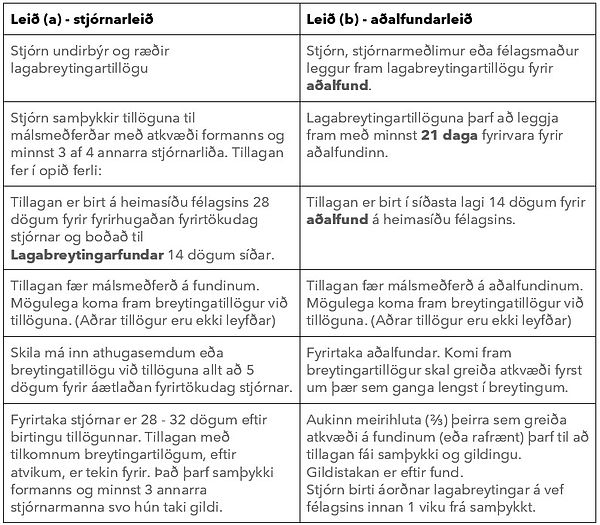
Overview Table of the Bylaw Amendment Process under the Bylaws (Art. 2.31c and Art. 2.41)
Route (a) – Board route
Route (b) – Annual general meeting route
The Board prepares and discusses an amendment proposal
The Board, a Board member, or a member submits an amendment proposal before the annual general meeting
The Board approves the proposal for processing by a vote of the Chair and at least 3 of the other 4 Board members. The proposal enters an open process:
The proposal must be submitted at least 21 days before the annual general meeting
The proposal is published on the website 28 days before the Board’s intended decision date and an Amendment Meeting is convened 14 days later
The proposal is published on the website no later than 14 days before the annual general meeting
The proposal is processed at the meeting. Amendment proposals may arise. (Other proposals are not permitted)
The proposal is processed at the annual general meeting. Amendment proposals may arise. (Other proposals are not permitted)
Comments or an amendment proposal may be submitted up to 5 days before the Board’s scheduled decision date
Decision at the annual general meeting. If amendments are proposed, voting shall first occur on those that go furthest in changes
The Board decision takes place 28–32 days after publication. The proposal, with resulting amendments as applicable, is considered. It requires approval of the Chair and at least 3 other Board members to enter into force
An increased majority (⅔) of those voting at the meeting (or electronically) is required for adoption and validation. Entry into force is after the meeting
The Board publishes adopted bylaw amendments on the website within 1 week of adoption
—
Article 3. Humanist Policy Standards
All work of the association and the conduct of its representatives shall reflect the moral and epistemic realism that underlies common humanist humanism in Ideological Foundation of Flourishing and other policy-forming resolutions of the association. All representatives of the association shall work according to standards of professionalism regarding good morality, knowledge and competence in the matters concerned, moral disposition (virtues), and communicative competence in all interactions. In addition to the ideological foundation, members adopt ethical guidelines and potentially more specific rules of conduct as standards, as applicable.
Article 4. Finances
4.1. Financial management (authorized signatories) shall follow agreement, or the majority will of the Board.
4.2. The Board is not permitted to place the association in negative liquidity (debts exceeding available or readily realizable funds) except in cases of temporary emergency.
4.3. The financial year is the calendar year. The Treasurer shall deliver the annual accounts to the auditors 3 weeks before the planned annual general meeting. The auditors of the annual accounts shall complete their review of the Treasurer’s annual accounts and notify the Treasurer and the Board of approval or comments at least 14 days before the annual general meeting. The endorsed annual accounts shall preferably be published 7 days, but at least 3 days, before the date of the annual general meeting. Under Act no. 108/1999, as amended, the Board shall submit the association’s annual accounts to the District Commissioner, together with an annual report on operations, before the end of March each year.
4.4. The Treasurer shall present the annual accounts for presentation, discussion, and approval at the annual general meeting.
Article 5. Dissolution and Extraordinary General Meeting
5.1. If both four-fifths (⅘) of the Board and at least two-thirds (⅔) of all members, in a subsequent vote, decide to dissolve the association, a lawfully convened extraordinary general meeting (or annual general meeting) shall be held within 1–3 months. If at least four-fifths (⅘) of the members present at the meeting approve the dissolution, it shall proceed; otherwise, a new functioning Board shall be elected to continue operations.
5.2. If it proves impossible to form a functioning Board (at least three members) to work toward the association’s objectives by the end of March of the working year and after the annual general meeting has concluded, an extraordinary general meeting shall be convened within 3 months from the end of the previous one to seek and announce nominations. If it is still not possible to form the minimum number (3+1) for the Board at that meeting, the former Chair and Treasurer shall document and notify the dissolution of the association.
5.3. If the association is dissolved as above, all remaining liquid funds (after payment of outstanding debts) shall be allocated to the Department of Philosophy at the University of Iceland or to a comparable humanist life-stance association domestically (and alternatively abroad).
5.4. The Board may decide to place the association’s operations on hold if unusual circumstances arise in society (e.g., due to an epidemic of a dangerous infection) and to resume them when conditions improve. A decision to this effect shall be published on the association’s website (or alternatively by other available means of public notice) together with appropriate explanations.
Adopted by the founding members at the founding meeting of Flourishing on 23 March 2025 at Safnahúsið, Reykjavík.
Amendment History
Amendments on 16 October 2025 adopted by the Board of Flourishing.
These amendments are additions in the form of more specific reference to Act no. 108/1999 on religious and life-stance associations, which was adopted at the founding of the association as the legislation under which the association would operate. This is therefore not a substantive change, but a clarification, and therefore does not require a special bylaw amendment process beyond review by the Board for adoption. The Chair of the association submitted the amendments following guidance from a representative of the District Commissioner (per letters to the association dated 10 October 2025 and 16 October 2025).
Article 1.1. “The association is named Flourishing – a humanist life-stance association. [After its official registration as a life-stance association it shall operate in accordance with national legislation no. 108/1999, as amended.]” becomes:
“1.1. The association is named Flourishing – a humanist life-stance association. As a life-stance association it operates in accordance with national legislation no. 108/1999 on religious and life-stance associations, as amended.”
In Article 2.31c, the last sentence on eligibility for election as Chair or Board member states: “Eligibility also requires a clean criminal record.” For more specific statutory reference under Act no. 108/1999, the following is added:
“Eligibility also requires a clean criminal record and, pursuant to Act no. 108/1999, a candidate for Chair must have reached 25 years of age at election and be liable for sóknargjöld in Iceland. Board members must have at least half of their number resident in Iceland, or one more if the number is odd. Board members, the head [Chair] and deputies [ceremony leaders] shall at all times meet the statutory eligibility requirements for service on the Board of the association. If Board members, an appointed custodian of funds [or, as applicable, an executive director] lose eligibility for Board service or the office, they shall inform the District Commissioner of this. Board members shall give a true and correct account of the association’s circumstances in public advertisements or notices, reports, annual accounts, or notifications to the District Commissioner.”
For clarification of the District Commissioner’s check of the residence requirement, the following is placed in footnote text:
“To confirm this, Board members and ceremony leaders must submit a certificate of legal domicile/guardianship (búsforráðsvottorð) to the District Commissioner.”
In the final paragraph of Article 2.31c the following is added:
“Adopted amendments to these bylaws must be notified to the District Commissioner pursuant to Act no. 108/1999, as amended.”
and the following clarification in footnote text beneath it:
“Because the association’s formal registration is conditional upon nothing having been changed contrary to the content of national legislation. If the bylaws violate national legislation, good morality, or public order, the conditions for registration are no longer met and the association’s registration could then be revoked, cf. paragraph 1 of Article 6 of Act no. 108/1999.”
In Chapter 4 on finances, Article 4.3 adds:
“Under Act no. 108/1999, as amended, the Board shall submit the association’s annual accounts to the District Commissioner, together with an annual report on operations, before the end of March each year.”
In Chapter 1.4 on ceremony leaders, the following is added:
“Under Act no. 108/1999, as amended, ceremony leaders [deputies performing the official duties of the head] shall sign a declaration to the effect ‘to perform with vigilance and conscientiousness the duties that the office places upon [them]’ and ‘to declare [their] fitness for the office’ in accordance with this Act and the provisions of Chapters III and IV of the Marriage Act (no. 31/1993). Ceremony leaders shall have reached at least 25 years of age.”